TAP Programs for Students

TAP Programs for students include a yearly Research Prize Award and Travel Grants awarded to students for exceptional theoretical astrophysics research and Travel and Training Grants to support students with training, travel for research collaboration, or conference attendance, to support educational and research pursuits and preparation for entering the future job market.

Graduate Student Research Prize


The Theoretical Astrophysics Program (TAP) seeks to award one student at the University of Arizona with the Graduate Student Research Prize. This competition, held annually, is an opportunity to highlight students conducting exceptional theoretical astrophysics research. The application period opens each fall semester with applications due early January. Graduate students are encouraged to apply before the final year of their program. 

The winner of the competition will receive a commemorative plaque, a $1000 cash award, and an invitation to present their work during the spring colloquia series. Review and selection are done by committee and based on the quality and originality of the research.

Each year, the competition will be announced in the Fall. Awardee will be invited to provide a TAP Colloquia in Spring. Join the TAP mailing list to receive future announcements.

1) Must be either a current grad student and working with a TAP General Faculty Member.

2) Have submitted or published a research paper within the last 2-years in a peer-reviewed journal. 

3) Complete the TAP Research Prize application including:

  • Provide a one-page summary outlining the importance and context of the work.  See instructions at the application link.
  • Submit endorsement statement by TAP Faculty advisor, including an estimate of the student’s percent contribution to both the research and the writing (minimum 60% student contribution expected).

Please contact Rosie Johnson, TAP Project Manager, with any questions

TAP Graduate Student Research Prize Awardees

Sóley Hyman, Astronomy

PECCARY:  A Novel Approach for Characterizing Orbital Complexity, Stochasticity, and Regularity
Image
Soley Hyman

Abstract:  Permutation Entropy and statistiCal Complexity Analysis for astRophYsics (PECCARY) is a computationally inexpensive, statistical method by which any time series can be characterized as predominantly regular, complex, or stochastic. Elements of the PECCARY method have been used in a variety of physical, biological, economic, and mathematical scenarios, but have not yet gained traction in the astrophysical community. This study introduces the PECCARY technique with the specific aims to motivate its use in and optimize it for the analysis of astrophysical orbital systems. PECCARY works by decomposing a time-dependent measure, such as the xcoordinate or orbital angular momentum time series, into ordinal patterns. Due to its unique approach and statistical nature, PECCARY is well suited for detecting preferred and forbidden patterns (a signature of chaos), even when the chaotic behavior is short-lived or when working with a relatively short-duration time series or small sets of time-series data. A variety of examples are used to demonstrate the capabilities of PECCARY. These include mathematical examples (sine waves, varieties of noise, well-known chaotic functions), a double pendulum system, and astrophysical tracer particle simulations with potentials of varying intricacies. Since the adopted timescale used to diagnose a given time series can affect the outcome, a method is presented to identify an ideal sampling scheme, constrained by the overall duration and the natural timescale of the system. The accompanying PECCARY Python package and its usage are discussed.


The Astrophysical Journal, Volume 987, Number 2

View on YouTube


Eonho Chang, Applied Math

“Halfway to Rayleigh” and Other Insights into the Rossby Wave Instability
Image
Eonho Chang  holding 2025 Research Prize Plaque

Abstract:  The Rossby wave instability (RWI) is the fundamental nonaxisymmetric radial shear instability in disks. The RWI can facilitate disk accretion, set the shape of planetary gaps, and produce large vortices. It arises from density and/or temperature features, such as radial gaps, bumps, or steps. A general, sufficient condition to trigger the RWI is lacking, which we address by studying the linear RWI in a suite of simplified models, including incompressible and compressible shearing sheets and global, cylindrical disks. We focus on enthalpy amplitude and width as the fundamental properties of disk features with various shapes. We find analytic results for the RWI boundary and growth rates across a wide parameter space, in some cases with exact derivations and in others as a description of numerical results. Features wider than a scale height generally become unstable about halfway to Rayleigh instability, i.e., when the squared epicyclic frequency is about half the Keplerian value, reinforcing our previous finding. RWI growth rates approximately scale as enthalpy amplitude to the 1/3 power, with a weak dependence on width, across much of the parameter space. Global disk curvature affects wide planetary gaps, making the outer gap edge more susceptible to the RWI. Our simplified models are barotropic and height integrated, but the main results should carry over to more complex and realistic scenarios.
 

The Astrophysical Journal, Volume 976, Number 1

View on YouTube

Yangyang Cai, Physics

Dynamics of Ultrarelativistic Charged Particles with Strong Radiation Reaction in Aristotelian Equilibrium
Image
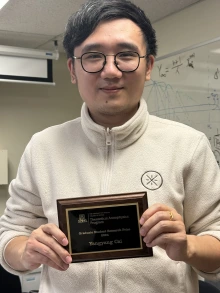
Yangyang Cai received 2025 Grad Student Research plaque

Abstract:  As first proposed by Gruzinov, a charged particle moving in strong electromagnetic fields can enter an equilibrium state where the power input from the electric field is balanced by radiative losses. When this occurs, the particle moves at nearly light speed along special directions called the principal null directions (PNDs) of the electromagnetic field. This equilibrium is “Aristotelian” in that the particle velocity, rather than acceleration, is determined by the local electromagnetic field. In Paper I of this series, we analytically derived the complete formula for the particle velocity at leading order in its deviation from the PND, starting from the fundamental Landau-Lifshitz (LL) equation governing charged particle motion, and demonstrated agreement with numerical solutions of the LL equation. We also identified five necessary conditions on the field configuration for the equilibrium to occur. In this paper we study the entry into equilibrium using a similar combination of analytical and numerical techniques. We simplify the necessary conditions and provide strong numerical evidence that they are also sufficient for equilibrium to occur. Based on exact and approximate solutions to the LL equation, we identify key timescales and properties of entry into equilibrium and show quantitative agreement with numerical simulations. Part of this analysis shows analytically that the equilibrium is linearly stable and identifies the presence of oscillations during entry, which may have distinctive radiative signatures. Our results provide a solid foundation for using the Aristotelian approximation when modeling relativistic plasmas with strong electromagnetic fields.


Physical Review D, Volume 108, Number 063018

View on YouTube


Haowen Zhang, Physics

Trinity I: Self-consistently Modelling the Dark Matter Halo–Galaxy–Supermassive Black Hole Connection from z = 0–10
Image
Haowen Zhang

Abstract:  We present Trinity, a flexible empirical model that self-consistently infers the statistical connection between dark matter haloes, galaxies, and supermassive black holes (SMBHs). Trinity is constrained by galaxy observables from 0 < z < 10 [galaxies’ stellar mass functions, specific and cosmic star formation rates (SFRs), quenched fractions, and UV luminosity functions] and SMBH observables from 0 < z < 6.5 (quasar luminosity functions, quasar probability distribution functions, active black hole mass functions, local SMBH mass–bulge mass relations, and the observed SMBH mass distributions of high-redshift bright quasars). The model includes full treatment of observational systematics [e.g. active galactic nucleus (AGN) obscuration and errors in stellar masses]. From these data, Trinity infers the average SMBH mass, SMBH accretion rate, merger rate, and Eddington ratio distribution as functions of halo mass, galaxy stellar mass, and redshift. Key findings include: (1) the normalization and the slope of the SMBH mass–bulge mass relation increases mildly from z = 0 to z = 10; (2) The best-fitting AGN radiative+kinetic efficiency is ∼0.05–0.06, but can be in the range ∼0.035–0.07 with alternative input assumptions; (3) AGNs show downsizing, i.e. the Eddington ratios of more massive SMBHs start to decrease earlier than those of lower mass objects; (4) The average ratio between average SMBH accretion rate and SFR is ∼10−3 for low-mass galaxies, which are primarily star-forming. This ratio increases to ∼10−1 for the most massive haloes below z ∼ 1, where star formation is quenched but SMBHs continue to accrete.


The Royal Astronomical Society, Volume 522, Issue 3

View on YouTube


Gabriele Bozzola, Astronomy

Does Charge Matter in High-energy Collisions of Black Holes?
Image
Gabriele Bozzola

We perform numerical-relativity simulations of high-energy head-on collisions of charged black holes with the same charge-to-mass ratio λ. We find that electromagnetic interactions have subdominant effects already at low Lorentz factors γ, supporting the conjecture that the details of the properties of black holes (e.g., their spin or charge) play a secondary role in these phenomena. Using this result and conservation of energy, we argue these events cannot violate cosmic censorship.


Physical Review Letters 128, 071101

View on YouTube

Nicolas Garavito-Camargo, Astronomy

Hunting for the Dark Matter Wake Induced by the Large Magellanic Cloud
Image
Nicolas Garavito-Camargo

Abstract:  Satellite galaxies are predicted to generate gravitational density wakes as they orbit within the dark matter (DM) halos of their hosts, causing their orbits to decay over time. The recent infall of the Milky Way’s (MW) most massive satellite galaxy, the Large Magellanic Cloud (LMC), affords us the unique opportunity to study this process in action. In this work, we present high-resolution (mdm = 4 × 10⁴M) N-body simulations of the MW–LMC interaction over the past 2 Gyr. We quantify the impact of the LMC’s passage on the density and kinematics of the MW’s DM halo and the observability of these structures in the MW’s stellar halo. The LMC is found to generate a pronounced wake, which we decompose in Transient and Collective responses, in both the DM and stellar halos. The wake leads to overdensities and distinct kinematic patterns that should be observable with ongoing and future surveys. Specifically, the Collective response will result in redshifted radial velocities of stars in the north and blueshifts in the south, at distances >45 kpc. The Transient response traces the orbital path of the LMC through the halo (50–200 kpc), resulting in a stellar overdensity with a distinct, tangential kinematic pattern that persists to the present day. The detection of the MW’s halo response will constrain the infall mass of the LMC, its orbital trajectory, and the mass of the MW, and it may inform us about the nature of the DM particle itself.
The Astrophysical Journal, Volume 884, Number 1

View on YouTube

Joshua Lothringer, Planetary Sciences

Youngmin JeongAhn, Planetary Sciences

Even Schneider, Astronomy

Tim Johannsen, Physics


Curtis Cooper, Planetary Sciences

Martin Pessah, Astronomy

Todd Thompson, Physics

Sharada Iyer, Physics

Chris L. Fryer, Astronomy

William Sears, Planetary Sciences

Student Travel & Training Grants

The TAP small matching grants program seeks to provide resources to undergraduate and graduate students to assist with training, travel for research collaboration, or confernece attendance to support their educational and research pursuits and help to prepare them for entering the future job market.

Grant awards up to $1,000 may be used for training opportunities, conferences, research-related travel, or professional supplies/equipment. Preference will be given to new applicants and those in the later stages of their degree program.

2027 TAP Travel/Training Grant Applications Now Being Accepted

These awards will be available for use July 1, 2026 - May 31, 2027 (travel/training may occur prior to July 1)

Application for Travel Grant

  Deadline to apply:  Monday March 9, 2026 by 5pm MST.

TAP Travel and Training Grant Awardees

2026 Travel Grant Recipients

Vadim BernshteynAstronomy
Rafael BertolottoAstronomy
Pranav ChiploonkarAstronomy
Hayden FooteAstronomy
Elaheh HayatiPhysics
Vikram ManikantanAstronomy
Mahdi NaseriAstronomy
Himansh RathoreAstronomy
Tyler ReesePlanetary Sciences
Rohin SantAstronomy
Neev ShahAstronomy
Hina SuzukiAstronomy
Aurora WildePhysics

2025 Travel Grant Recipients

Jonah BarberPhysics
Haley BowdenAstronomy
Eonho ChangApplied Math
Hayden FooteAstronomy
Nikhil GarudaAstronomy
Waverly GormanPhysics
Lori HusebyPlanetary Sciences
Vikram ManikantanAstronomy
Ian (Iggy) MathesonPlanetary Sciences
Maria MutzPhysics
Mahdi NaseriAstronomy
Himansh RathoreAstronomy
Neev ShahAstronomy
M SmithPhysics
Connor SweeneyPhysics
Erik WesselPhysics
Jackson ZariskiApplied Math

Jonah BarberPhysics
Jose Cisneros CastroPlanetary Sciences
Katie ChamberlainAstronomy
Eonho ChangAstronomy
Emmanouil DrimalasAstronomy
Hayden FooteAstronomy
Soley HymanAstronomy
Ian (Iggy) MathesonPlanetary Sciences
Pranjal RSAstronomy
Himansh RathoreAstronomy
M SmithAstronomy
Jackson ZariskyAstronomy


Yangyang CaiPhysics
Soley HymanAstronomy
Vikram ManikantanAstronomy
Ian MathesonPlanetary Sciences
Jiachuan XuAstronomy
Eonho ChangAstronomy

Gabriele BozzolaAstronomy
Jose CisnerosPhysics
Emmanouil DrimalasPhysics
Tintin NguyenAstronomy
Chang Tao YangPhysics
Jada WaltersPlanetary Sciences
Xiaozhou ZhaoPlanetary Sciences

Jiachuan XuAstronomy

Gabriele BozzolaAstronomy
Saverio CambioniPlanetary Sciences
Pedro EspinoPhysics
Hamish HayPlanetary Sciences
Rixin LiAstronomy
Rachel SmullenAstronomy
Maria SteinrueckPlanetary Sciences
Adam SutherlandAstronomy
Tyler TrentAstronomy

Carolynn RaithelAstronomy
Etka PatelAstronomy
James T. KeanePlanetary Sciences

Etka PatelAstronomy

Sabina Abate 
Atri BhattacharyaPhysics
Rixin LiAstronomy
Rachel SmullenAstronomy
Banner Image Credit:  Carl Fields