

Computational Training
TAP runs Hackathons and Computational Workshops to ensure exposure to state-of-the-art computational methods (machine learning/AI) and training in how to use astrophysical codes that drive cutting-edge research in Theoretical Astrophysics.
Upcoming Events
Fall 2026 Computational Workshops

Astrophysical Reaction Networks
Computational Workshop
November 17 & 18, 2026
Erika Holmbeck, Lawrence Livermore National Laboratory
TAP Stellar & Nuclear Astrophysics Initiative
REGISTER HERE

Do you Believe Your Own Error Bars? Diagnostics for Bayesian Inference in Astrophysics
Computational Workshop
December 8 & 9, 2026
Luis Welbanks, Arizona State University
TAP Planetary Atmospheres Initiative
REGISTER HERE

Exploring Tabular Foundation Models in Astronomy
Computational Workshop
December 15 & 16, 2026
Joshua Speagle, University of Toronto
TAP Computation & Data Initiative
REGISTER HERE
Spring 2027 Computational Workshops

Numerical Plasma Dispersion Relations: Hands-on Tutorials with PLUME and ALPS
Computational Workshop
April 12 & 13, 2027
Kristopher Klein, University of Arizona
TAP Plasma Physics Initiative
Computational Training Resources
High Performance Computing (HPC)
The University of Arizona offers free high performance computing resources in the Research Data Center (RDC), a state-of-the-art facility that hosts large computer clusters. Scientific research relies upon such systems to analyze massive amounts of collected data.
Benefits:
Several HPC clusters support different research computing needs whether it is for hundred’s of small jobs that only use a few cores each, or very large jobs using hundreds of cores or terabytes of memory. Or anything in between. There are also many nodes with Nvidia GPU’s.
Details are available at Compute Resources.
Service Offerings:
- A web interface to the cluster offers a file browser, a graphical desktop, and the Jupyter notebooks and RStudio applications
- An account management portal which lets you manage your account and request services
- Workshops and training in a range of HPC subjects from Introductory HPC to MPI
- The HPC is not compliant for export-controlled or CUI data
Previous Events
Spring 2026 Computation & Data Initiative Workshops

Applications of Unsupervised Machine Learning Techniques for Data Exploration and Discovery in Astronomy
Dalya Baron, Stanford Universtiy
March 27, 2026
Computation & Data Initiative Computational Workshop

Agentic Coding For Research Problems
Kaitlin Kratter & CK Chan, University of Arizona
April 1, 2026
TAP Computation & Data Initiative: Computational Workshop and Hackathon
No Recording Available
Fall 2025 Computation & Data Initiative Workshops

Numerical Astrophysics with PLUTO: Physics, Code, and Applications
Joanna Kramer, Los Alamos National Laboratory
Two Sessions: Sep 30 & Oct 1, 2025
No Recordings Available
2024-Spring 2025 CDI Computational Workshops
Hack Arizona Event
March 22, 2025
TAP Computation & Data Initiative hosted three Hack Arizona sessions

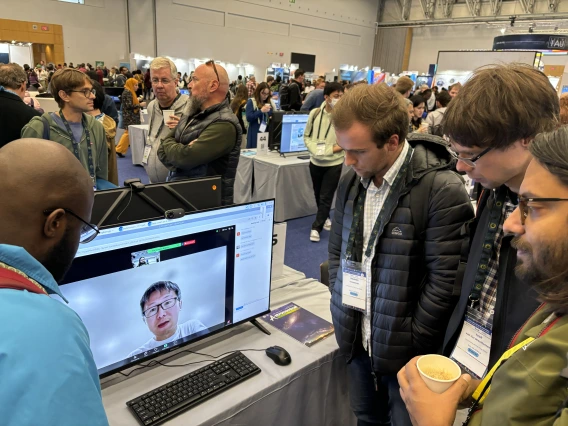
The IAU 2024 General Assembly in Capetown, South Africa
August 2024
TAP, a partner for the IAU 2024 General Assembly held in Capetown, South Africa, was featured in the event’s poster sessions and event website. This was an exceptional opportunity to be in front of a large global audience of potential faculty, postdocs, and graduate students. TAP Faculty Member Chi-Kwan Chan represented TAP with a project poster submission and Q&A.
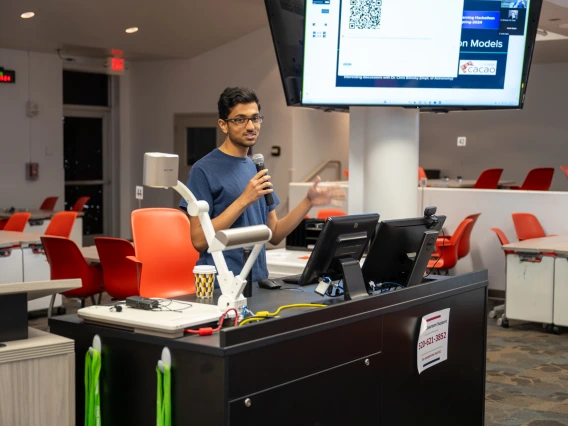
Deep Learning for Astrophysics Hackathons
Spring 2024
Organized under the TAP Computation and Data Initiative, Chi-Kwan Chan ran weekly hackathons (11 sessions) open to all TAP members in FY24. 18 participants from Astronomy, Physics, and Computer Science joined the hackathons. The sessions were designed to teach a variety of applications for deep learning in science, train on neural network learning, and provide hands-on experience working through challenging projects and solutions.
Overview doc of all the sessions
Links used for Hackathon Teaching Concepts:
Spring 2025 Cosmology Computational Workshops

From Zero to Generative: Learning Generative Models from Scratch
Carol Cuesta-Lazaro, Massachusetts Institute of Technology
TAP Cosmology Initiative Computational Workshop I
April 29, 2025
This workshop introduces generative modeling with no prerequisites in machine learning or deep learning. Starting with basic concepts, we guide participants through the intuition and implementation of key generative frameworks, such as diffusion models. Participants will gain hands-on experience building simple versions of these models and understanding when to apply different architectures.

Practical Session on Using Generative Models
Carol Cuesta-Lazaro, Massachusetts Institute of Technology
TAP Cosmology Initiative Computational Workshop II
May 5, 2025
Speaker encourages everyone to use their own research.
Spring 2025 Dynamics Computational Workshop
Orbital Dynamics in Python
March 18, 2025
Daniel Tamayo, Harvey Mudd College
TAP Dynamics Initiative Computational Workshop
This computational workshop provided a hands-on introduction to the REBOUND N-body integration package. It introduced some of the basics, discussed its new visualization tools, as well as going through how to customize the code for your own scientific goals. We showed how various common astrophysical effects (tides, oblateness, radiation pressure etc.) can be easily incorporated using the REBOUNDx library, and how you can add your own custom effects. Finally, we introduced celmech, a new Python package for facilitating theoretical orbital mechanics calculations, and isolating the effects of resonances, secular dynamics, and much more!
Fall 2025 Planet Formation Initiative Computational Workshops

Smoothed Particle Hydrodynamics (SPH) Methods in Astrophysics
Cristiano Longarini, Cambridge University
Planet Formation Initiative Computational Workshop
Oct 7, 2025

Welcome to Swiftest! Welcome to Cratermaker!
David Minton, Purdue University
Planet Formation Initiative Computational Workshop
Title: Welcome to Swiftest! (Click button below to view on YouTube)
Oct 21, 2025
Title: Welcome to Cratermaker! (Click here to view on YouTube)
Oct 22, 2025
Fall 2024 Planet Formation Computational Workshops
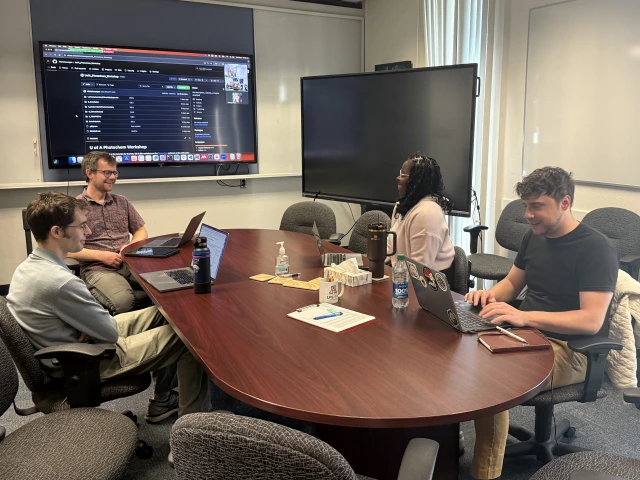
Photochem Workshop II
Nicholas Wogan, NASA Ames Research Center
November 5, 2024
An Open-Source Chemical and Climate Model of Planetary Atmospheres
Learning Objectives:
A brief introduction to photochemistry and climate modeling
Installing Photochem
First photochemistry simulation: a model of Modern Earth
Modifying chemical reaction rates or other internal model data (e.g., photolysis or aerosol cross sections)
Modifying the Photochem source code & contributing to the model
First climate simulations: reproducing the Habitable Zone
If we have time – a photochemistry and climate simulation of TRAPPIST-1e assuming it is an inhabited world.
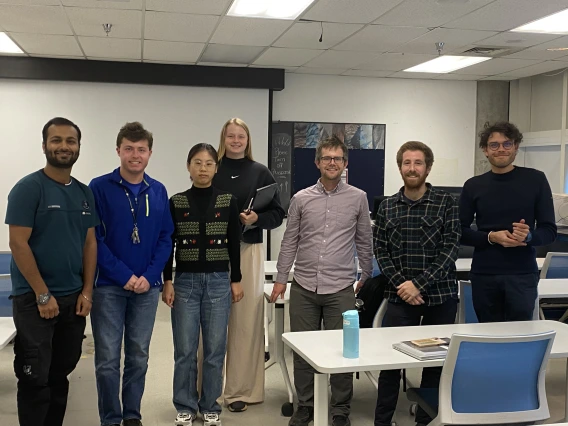
Photochem Workshop I
Nicholas Wogan, NASA Ames Research Center
November 5, 2024
An Open-Source Chemical and Climate Model of Planetary Atmospheres
Learning Objectives:
A brief introduction to photochemistry and climate modeling
Installing Photochem
First photochemistry simulation: a model of Modern Earth
Modifying chemical reaction rates or other internal model data (e.g., photolysis or aerosol cross sections)
Modifying the Photochem source code & contributing to the model
First climate simulations: reproducing the Habitable Zone
If we have time – a photochemistry and climate simulation of TRAPPIST-1e assuming it is an inhabited world.
Fall 2025 Planetary Atmospheres Computational Workshops

Introduction to MELT and SMINT: Modeling of Small-planet Interior Compositions.
Caroline Piaulet-Ghorayeb, University of Chicago
Planetary Atmospheres Computational Workshop
Oct 28, 2025